
The plug fits. Is the appliance compatible?
A travel adapter changes the connection between a plug and a wall socket. A voltage converter changes electrical voltage. Confusing the two can turn a tidy packing decision into a damaged appliance. The useful first question is therefore not which universal adapter has the most sockets, but what the device’s input label actually permits.
SKROSS explicitly states that its travel adapters do not convert voltage. Its guidance directs travelers to the appliance nameplate rather than assuming that every electronic device adjusts automatically. SKROSS: adapters and voltage.
Read input, not USB output
Look for the input-voltage and frequency range on the power supply or appliance. A label accepting 100–240V AC is different from a label restricted to one mains voltage. The output side describes what the charger delivers to its device; it does not tell you which wall supply the charger accepts.
Apple, for example, specifies a 100–240V AC, 50–60Hz range for its USB power adapters. That is a statement about those adapters, not a blanket approval for every item with an Apple connector or every third-party charger. Check the label on the exact power supply you are carrying. Apple USB power-adapter guidance.
Swipe or scroll the table sideways to compare every column.
| Item in the bag | What to read | What to verify at the destination |
|---|---|---|
| Laptop or phone charger | Mains input range on the charger | Socket type and a suitable adapter |
| Hair dryer or styling appliance | Exact voltage, frequency and wattage requirements | Manufacturer-approved use and any switching instructions |
| Grounded appliance | Electrical requirements and protective-earth needs | An adapter that preserves the required grounding arrangement |
| Multiport USB charger | Input range and output allocation | Regional plug, load limits and usable port combinations |
Heating appliances need their own decision
Do not assume that a hair dryer, straightener or kettle behaves like a phone charger. Start with that appliance’s manual. If its requirements do not match the destination supply, simply adding a plug adapter does not resolve the mismatch. A manufacturer-approved local appliance or accommodation-supplied option may be the more practical answer than carrying a converter.
Avoid choosing a converter merely by the largest wattage printed on a shopping result. Suitability depends on the appliance and converter instructions, including load type and operating conditions. If the combination is unclear, do not improvise with stacked adapters or power strips. This guide is a packing framework, not an electrical installation procedure.
Plan around the actual destinations
Write down every country on the itinerary, including a stop where you will work or recharge. Check the adapter’s stated destination coverage and whether it accepts the actual plug on your charger. Protective grounding deserves explicit attention: physical fit does not establish that an earth connection is maintained.
Apple’s World Travel Adapter Kit illustrates a different approach: region-specific attachments for compatible Apple power adapters. It is not a universal fitting for every charger or appliance. Match the accessory to the equipment instead of choosing by appearance. Apple World Travel Adapter Kit.
A smaller kit starts with fewer assumptions
Our suggestion is to separate the kit into two parts: compatible USB charging equipment and the appropriate mains connection for the itinerary. Then list anything outside that system, especially heating appliances. This makes it easier to spot the one item that needs a separate decision before departure.
The Anker charger shown below is an existing multi-device charging example from our edit. It is not a voltage converter or a universal plug adapter. Confirm its exact regional version, input label and output allocation before considering it for a trip. The photograph identifies the pictured charger; no travel or electrical testing is claimed.
Explore the options
This charger is a USB charging example, not a voltage converter or universal mains adapter. Verify the regional plug and exact input label.
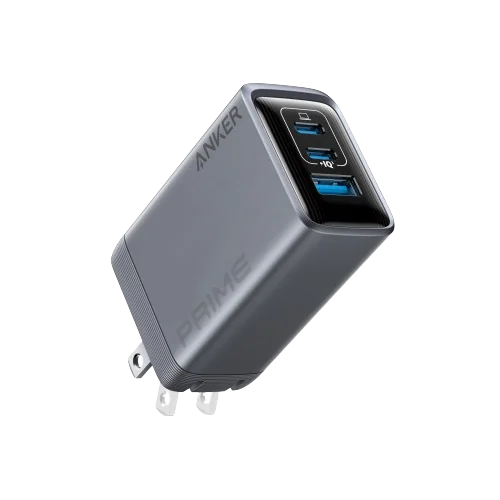
Anker Prime 100W three-port charger — A2688
A smaller-port-count option when one of your actual accessories uses USB-A.
As an Amazon Associate I earn from qualifying purchases. We may earn a commission from qualifying purchases through this button.
Check price & availability on Amazon ↗ (paid link)