Begin by emptying the bag
A travel charging kit should solve a small, specific problem: keeping the equipment you actually carry ready to use. It is easy to buy a powerful charger, a large power bank and a bundle of adapters, then discover that the bag is heavier and the bedside setup still awkward. Start with an inventory rather than a shopping list.
Write down each device, its charging connector and the power guidance from its manufacturer. Add the cable you need to connect it. Separate what must charge quickly during a short stop from what can charge slowly overnight. That distinction can reduce the size of the kit more effectively than chasing the largest output number on a product box.
One port is not the whole charger
A multiport charger has several power figures worth reading: total output, the capability of an individual port and the allocation when multiple devices are connected. Anker’s documentation for the 737 GaNPrime 120W gives different combinations, making it a useful example of why the headline total does not describe every port simultaneously.
Picture the real evening: laptop connected, phone low and perhaps a watch charging too. Check the manufacturer’s diagram for that combination. A charger that handles one device beautifully may not behave the way you expect with all ports occupied. The correct comparison is your likely charging arrangement, not the best single-port number from different products.
Choose the cables deliberately
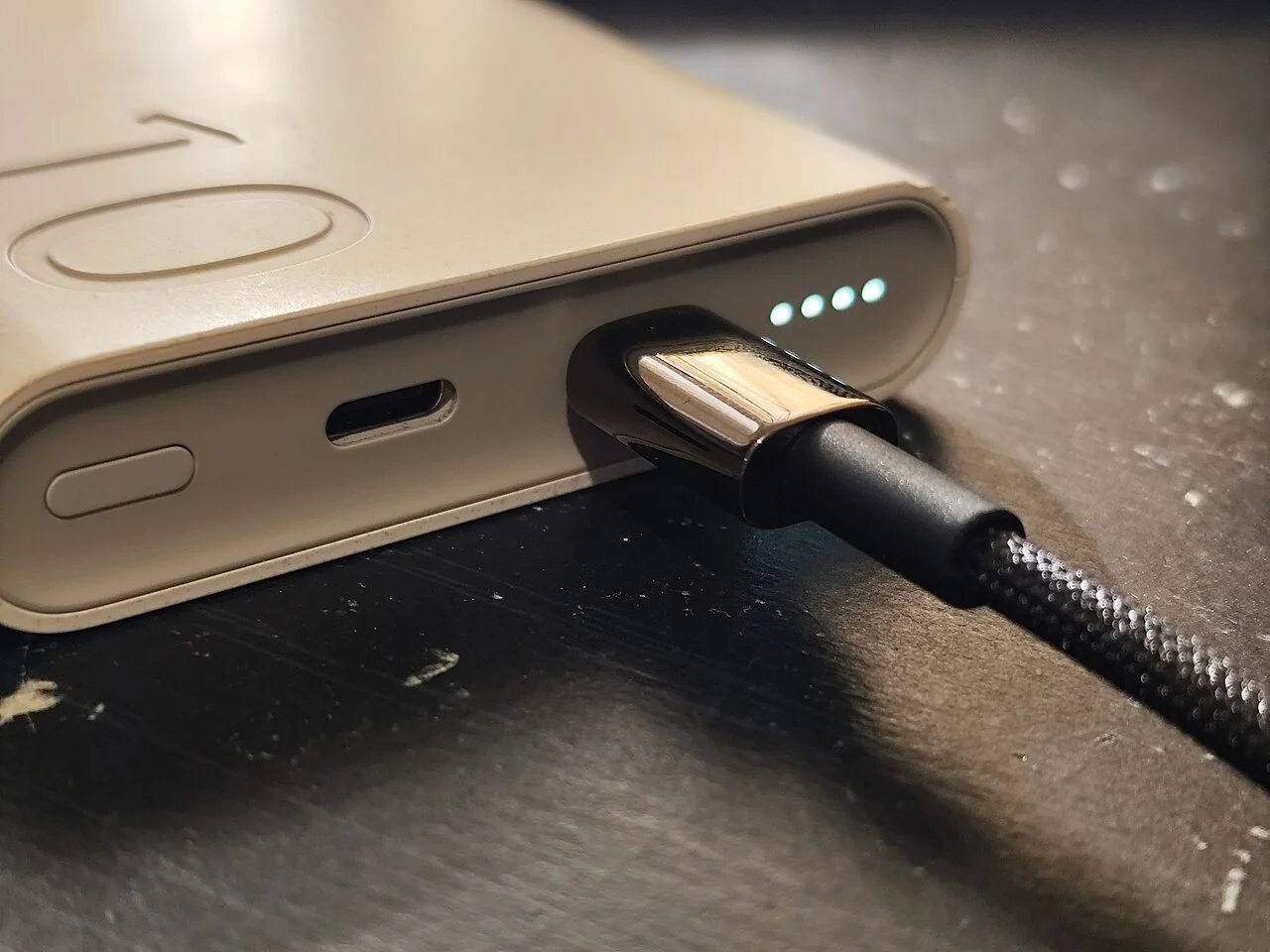
USB-C describes a connector family, and buying a cable by shape alone is a weak way to specify its job. Check the stated power capability and, if needed, data or display capability. The USB-IF documents power-delivery standards and cable identification. A cable purchased primarily for charging is not automatically the right one for an external display or high-speed storage.
For travel, pack the lengths that fit your routine. A short cable can keep a power bank tidy in a bag; a longer one may be more useful beside an inconvenient hotel outlet. Carrying several identical medium-length cables is not always the most flexible option. A small label can help distinguish the cable intended for the laptop from a lighter accessory lead.
Adapters and power banks have different jobs
A destination plug adapter addresses physical outlet compatibility. Do not assume that it changes voltage for every device you connect. Read the input rating on each charger and the adapter maker’s instructions. A familiar-looking socket is not sufficient information for an unfamiliar appliance, and a travel kit for electronics should not be treated as a universal solution for every electrical item.
A power bank is useful when access to a wall outlet is uncertain. Choose capacity and output around the device you need to rescue rather than treating maximum size as the goal. Confirm the rating on the actual bank, and check the airline and destination rules before flying. Buying a larger battery can add transport restrictions as well as weight.
Pack for the flight you are taking
The FAA directs passengers to carry spare lithium batteries and power banks in carry-on baggage, with capacity restrictions and additional conditions. Its guidance is a starting point for US travel, not a promise that every airline or jurisdiction uses identical operational rules. Read your carrier’s current policy, including any restrictions on using or charging a bank during the flight.
If a bag is taken at the gate, make sure the power bank remains with you as required. Protect battery terminals and avoid carrying damaged equipment. Keep the capacity marking readable. These small packing decisions are easier to make at home than while boarding, when the charger you intended to keep close may already be buried in a checked suitcase.
Our smallest useful kit
For many laptop-and-phone travelers, the sensible starting point is one appropriate multiport wall charger, a laptop-capable cable, a phone cable and the correct destination adapter. Add a power bank only when the itinerary makes it useful. Add a dedicated watch or proprietary charger when the device requires it. Treat this as an editorial template to adapt, not a universal packing requirement.
The Amazon search for the Anker 737 is an example to evaluate against that plan, not a claim that it is the lightest or fastest charger we have tested. Match the regional plug and exact model. Before departure, connect all of your devices together at home once. Finding a missing cable or an awkward power allocation before a trip is considerably more pleasant than finding it after midnight in a hotel.
Products to investigate
These are relevant configuration examples, rather than a tested ranking. Use the manufacturer information to confirm the complete specification.
Anker 737 Charger, GaNPrime 120W
An example of a documented multiport charger to compare with your devices.
Evidence: manufacturer information ↗ · Research checked October 18, 2026
USB-C 240W charging cable
A capability-specific search when a suitable high-power cable is needed.
Evidence: manufacturer information ↗ · Research checked October 18, 2026