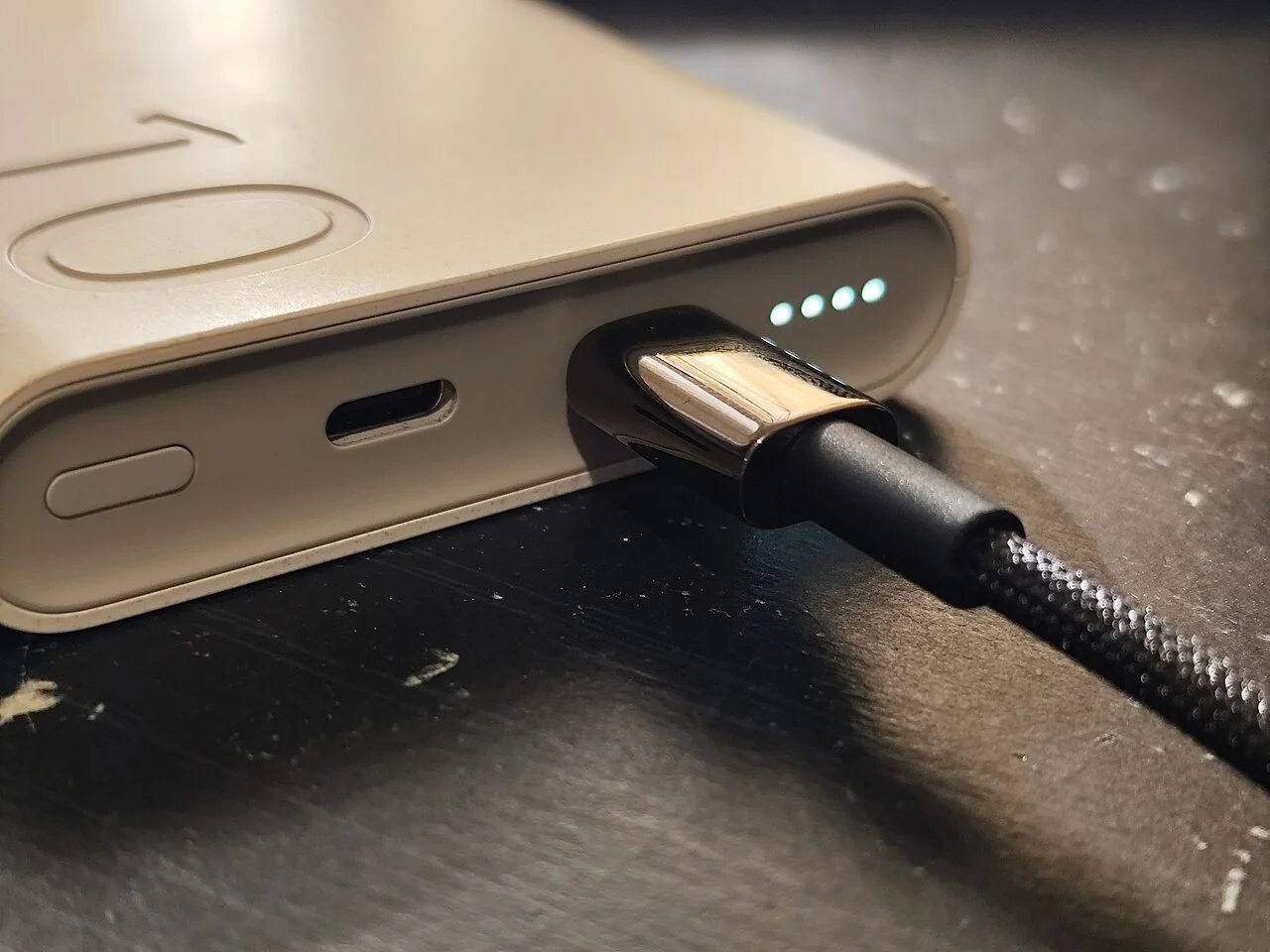
The considered selection
The useful travel charging kit is the one you understand when you are tired. A phone-first day bag and a laptop-heavy working trip do not need the same battery or wall charger. Start with your devices’ requirements and the cables you already carry; adding output you cannot use usually adds bulk as well.
These are research-based candidates, not charging-speed or endurance test winners. Wall chargers need an outlet, while power banks store energy. For flights, check the current airline and route rules directly before packing a battery. This list does not certify any item as airline-approved or promise a particular number of recharges.
How to use this list
- Match device charging requirements and cable ratings.
- Read the power-sharing table for devices that charge together.
- Check destination plug requirements and current transport rules separately.
The numbers organize ten distinct choices. They are not performance scores or Amazon sales ranks. Pick the item that solves your own problem; there is no need to buy the whole list.
Anker Prime Charger 100W, 3 Ports, A2688
Consider it for: For a laptop-and-phone outlet kit
This is a candidate for travelers who want one wall charger to cover a compatible laptop and smaller devices. The three-port layout is useful only if the simultaneous allocation fits the devices you plug in. Plan a typical evening—computer, phone and accessory—and compare that pattern with the manufacturer’s table. That is more informative than choosing by headline wattage alone.
Evidence: manufacturer information ↗ · Research checked October 18, 2026
Anker 735 Charger, Nano II 65W, A2667
Consider it for: For an established smaller multi-port option
The Nano II 65W A2667 is an established option to compare when your travel devices do not need a larger charger’s output. Its place on the list is deliberately specific, because Anker’s numbering can hide distinct products. Review the exact model and current manual, then decide whether the device mix is simple enough for a smaller shared power budget.
Evidence: manufacturer information ↗ · Research checked October 18, 2026
Anker Charger 140W, 4-Port, A2697
Consider it for: For a more demanding multi-device trip
A four-port charger is a candidate for a trip in which several devices must return to service at once. The A2697 offers a display and a larger power budget, but the purchase still starts with the actual load. Write the devices beside the relevant port combinations. If most evenings involve only a phone, carrying this much charging hardware may be unnecessary.
Evidence: manufacturer information ↗ · Research checked October 18, 2026
Apple 70W USB-C Power Adapter
Consider it for: For a straightforward compatible Mac charging kit
Apple’s single-port adapter is a candidate for a traveler who prefers a simple, manufacturer-recommended charging arrangement for a compatible Mac. It gives up multi-device convenience in favor of one clear job. Consider it when the laptop is the priority and other devices can charge at another time. Include the correct cable in the purchase plan rather than assuming one is supplied.
Evidence: manufacturer information ↗ · Research checked October 18, 2026
Belkin BoostCharge Pro 65W dual USB-C charger, BBC013-BK
Consider it for: For two USB-C devices at an outlet
The Belkin dual-port model is a candidate when the kit has moved entirely to USB-C and two connections are sufficient. The absence of an extra legacy port can be a useful simplification rather than a limitation if your cables already match. Compare the two-device allocation with the charging needs of the laptop and phone you plan to use together.
Evidence: manufacturer information ↗ · Research checked October 18, 2026
Anker Laptop Power Bank 25K, 165W, A1695
Consider it for: For a laptop-focused bag with fewer loose cables
The A1695 is a candidate for work trips where charging away from an outlet is a specific need. Its built-in and retractable cable arrangement can simplify packing, but also makes cable design part of the ownership decision. Consider where the battery will sit while charging and whether the extra capacity is worth carrying on the days you do not use it.
Evidence: manufacturer information ↗ · Research checked October 18, 2026
Anker Power Bank 24K, 140W, A1289
Consider it for: For a substantial separate-cable battery
The A1289, also known as the 737 Power Bank or PowerCore 24K, is an established candidate for a compatible laptop charging setup. It suits a buyer who wants to choose and replace cables separately. Compare the carrying weight with the time actually spent away from outlets; a larger battery is useful when that need is regular, rather than merely imaginable.
Evidence: manufacturer information ↗ · Research checked October 18, 2026
Anker Nano Power Bank 10K, 45W, retractable USB-C, A1638
Consider it for: For a phone-first day bag
The A1638 is a candidate when the priority is keeping a phone or similar device working through a day, with a built-in cable ready to use. That is a more focused role than replacing a laptop charger. Consider the connector on every device you own before valuing the integrated cable; a convenient feature becomes less useful when the rest of the kit still needs adapters.
Evidence: manufacturer information ↗ · Research checked October 18, 2026
UGREEN Nexode Power Bank 20,000mAh 100W, 25188
Consider it for: For a separate-cable multi-device battery
The 25188 is a candidate for travelers comparing laptop-capable power banks without committing to built-in cables. Review its input requirement as well as its output: the charger you use to refill a battery can affect how useful it is on a short stop. Decide which devices need power together, then inspect the corresponding allocation rather than the family’s largest number.
Evidence: manufacturer information ↗ · Research checked October 18, 2026
UGREEN Nexode Power Bank 12,000mAh 100W
Consider it for: For a smaller high-output shortlist
The 12,000mAh Nexode is a candidate for someone who wants a smaller battery to compare with larger laptop-focused packs. Higher output and more stored energy are different characteristics; reducing capacity can be sensible when you need a short top-up rather than a complete working day away from power. Check how output changes when both connections are used.
Evidence: manufacturer information ↗ · Research checked October 18, 2026
The last word
Pack around a real charging routine: a wall charger for the evening, the minimum battery that covers the day, and clearly identified cables. Test the whole arrangement with your own devices before departure. It is easier to solve an incompatible cable at home than beside an unfamiliar hotel outlet.
Check manufacturer notices for the exact model, keep the device label legible, and consult your carrier’s current battery rules. A retailer’s travel description is not a substitute for the requirements of the trip you are taking.