
Usually, yes: an undamaged power bank within your airline’s capacity and quantity limits belongs in your carry-on, never your checked suitcase. But permission to bring one does not automatically include permission to use it during the flight. In 2026, that distinction matters more than a reassuring “airline approved” line on a shopping page.
Check three things before leaving: the watt-hour rating printed on the unit, the rules of every operating airline on your itinerary, and the condition of your particular battery. The following guidance was researched on October 21, 2026; airline policies can change before your next departure.
Start with the printed watt-hours
Watt-hours, abbreviated Wh, describe stored energy. Watts, abbreviated W, describe power. A charger advertised at 140W is not automatically a 140Wh battery. Its maximum output and its energy capacity answer different questions.
The FAA’s current passenger guidance allows rechargeable batteries up to 100Wh, requires carrier approval for the next category up to 160Wh, and prohibits batteries over 160Wh under the ordinary passenger allowance. Power banks are treated as spare batteries and cannot go into checked baggage. FAA passenger battery guidance.
Swipe or scroll the table sideways to compare every column.
| Printed energy capacity | Initial planning position |
|---|---|
| Up to 100Wh | Common carry-on category; check airline quantity and use restrictions |
| Over 100Wh through 160Wh | Do not assume acceptance; obtain operating-airline approval where permitted |
| Over 160Wh | Outside the ordinary passenger allowance |
| Missing or unreadable | Resolve the identification before travel; acceptance cannot be assumed |
The label on your physical unit is more useful than a marketplace title. Similar-looking models can have different capacities, and a seller’s general description cannot establish the identity of the battery in your bag.
Converting mAh without making the common mistake
The conversion is watt-hours = milliampere-hours divided by 1,000, multiplied by nominal battery voltage. Use the correct voltage for the stated battery capacity. Do not casually substitute a USB port’s 5V output or a laptop charging mode’s 20V rating.
For illustration, 10,000mAh at 3.7V is 37Wh; 20,000mAh at 3.7V is 74Wh. Those are arithmetic examples, not specifications for every product carrying those mAh numbers. The manufacturer’s printed Wh rating should guide the actual travel check. FAA conversion explanation.
The Anker 737 Power Bank, model A1289, illustrates why precision matters. Anker identifies this model as a 24,000mAh, 140W product; its official Taiwan specification lists 86.4Wh. Multiplying its headline capacity by a generic 3.7V would instead produce 88.8Wh. Both are below 100Wh, but only the model’s own specification and label identify it correctly. Anker A1289 specifications, Anker model manual.
The 2026 international change
ICAO approved a power-bank addendum on March 27, 2026. IATA’s operator guidance explains the changes: no more than two power banks per person, no recharging a power bank onboard, and a recommendation against using one to recharge another device onboard. Individual protection against short circuits remains required. ICAO addendum explanation, IATA operator guidance.
These materials also explain why advice can appear inconsistent. Implementation interacts with national requirements and airline operations. The FAA’s October guidance still describes no numerical limit for personal-use rechargeable batteries below 100Wh, while expressly warning that airlines may apply stricter limits. Do not turn that FAA statement into a promise that an international carrier will accept several power banks.
For travel planning, check the airline’s published power-bank policy directly, even for a domestic itinerary. If you connect between carriers, each operating airline’s conditions matter. A ticket seller’s general baggage page may not resolve a partner-operated flight.
Carrying and using are different permissions
Emirates provides a useful example of a stricter airline policy. Its current dangerous-goods page permits one power bank with a maximum capacity of 100Wh and visible capacity information. It prohibits both charging devices from that power bank onboard and charging the power bank from the aircraft’s power supply. It also prohibits overhead-compartment storage, directing passengers to accessible storage at the seat. Emirates power-bank policy.
That is an Emirates rule, not a universal description of every airline. It shows why buying an under-100Wh model solves only part of the decision. If your plan depends on using battery power during a long flight, check onboard-use permissions before choosing a product or relying on it for work.
Pack for a gate-check surprise
Keep the power bank accessible in your cabin bag, protected from damage and short circuits. Disconnect cables when storing it and use a protective pouch or other suitable protection. Avoid leaving a loose unit where keys or other metal objects can contact exposed terminals.
If staff take your carry-on at the gate for transport in the hold, remove the power bank before handing the bag over. This is a frequent point where a correctly packed cabin item can end up in the wrong place. IATA’s passenger guidance specifically calls attention to gate-check removal. IATA passenger battery guidance.
Do not travel with a swollen, damaged, overheating or recalled battery. Check the manufacturer’s current recall information against the exact model and serial number. If a battery becomes hot, emits smoke or behaves abnormally in the cabin, alert the crew immediately rather than trying to conceal or continue using it.
Buy for the itinerary you actually have
A clearly labeled battery comfortably within your carrier’s limit is easier to evaluate than a maximum-capacity product with ambiguous documentation. Consider weight, the devices you need to charge at the destination and the airline’s actual use policy alongside charging speed.
Before each trip, photograph the model and capacity label, read the operating airline’s current policy, and keep the unit within reach when boarding. Those small checks are more useful than treating any power bank as permanently approved for every aircraft.
Explore the options
Exact product examples for the choices discussed in this guide. Confirm the selected variant, current seller and return terms before ordering.
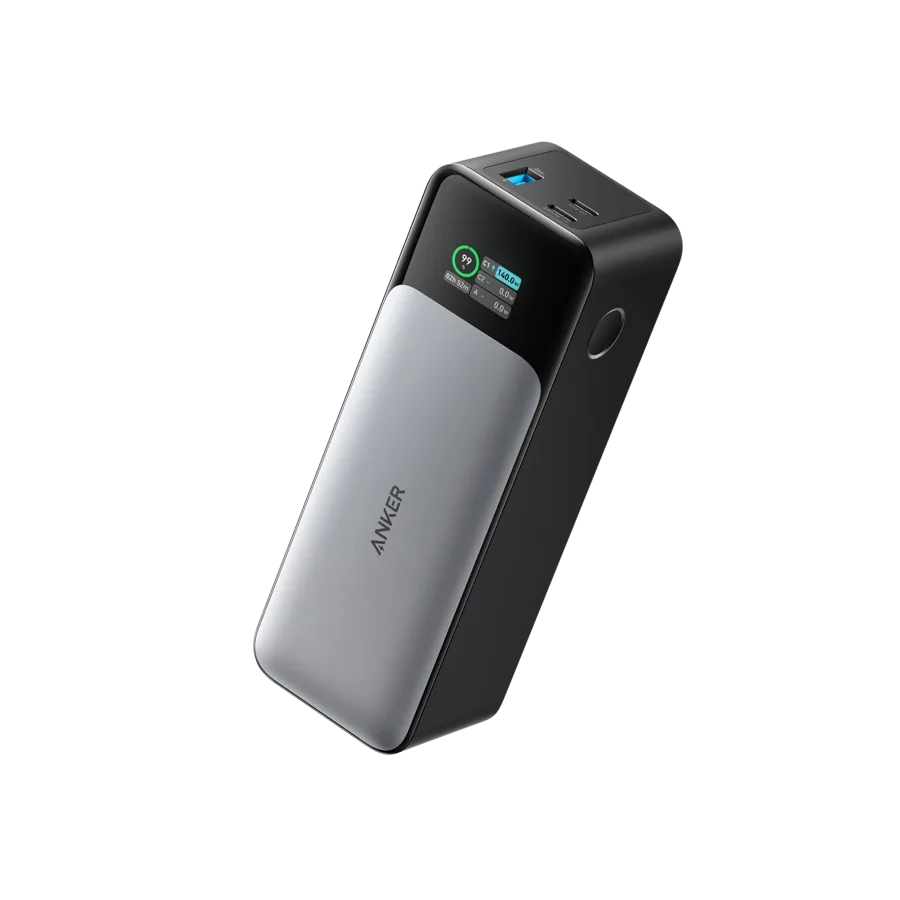
Anker 737 Power Bank — A1289
A high-capacity laptop bank example whose 86.4Wh label still needs checking against your operating airline’s policy.
As an Amazon Associate I earn from qualifying purchases. We may earn a commission from qualifying purchases through this button.
View exact product on Amazon ↗ (paid link)