
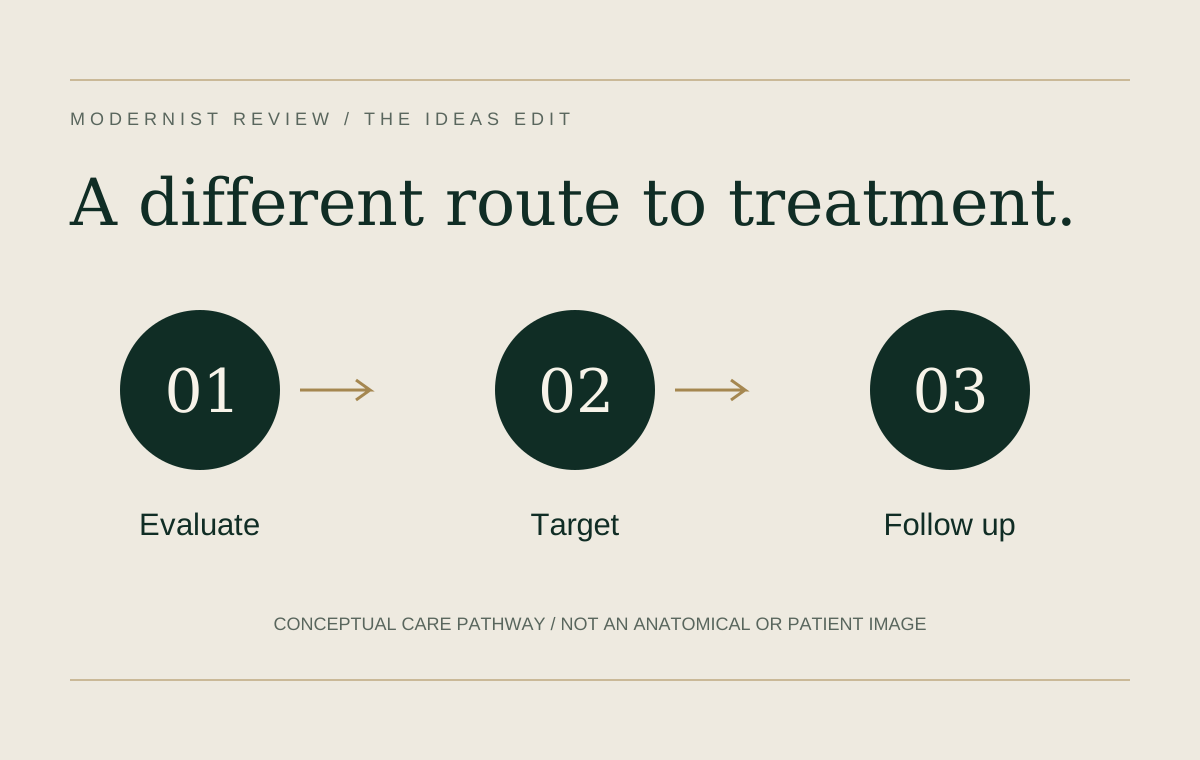
Modern medical technology often changes the route to a familiar treatment goal. For men with urinary problems caused by an enlarged prostate, prostate artery embolization—also called prostatic artery embolization, or PAE—offers an approach through the blood vessels supplying the gland. It can reduce symptoms without surgically removing prostate tissue. [1]
That makes PAE a worthwhile subject for a technology magazine. The innovation joins imaging, catheter navigation, and carefully targeted treatment. The patient question is practical: could this approach provide enough relief with a recovery and side-effect profile that fits my priorities?
Relationship disclosure: The editor is the owner of 1Prostate, the practice linked in this article. This feature covers a service offered by that practice. Clinical comparisons draw on external evidence; the practice link is an affiliated resource, rather than an independent endorsement.
Start with the obstruction
The prostate surrounds the urethra below the bladder. Benign prostatic hyperplasia, or BPH, is noncancerous enlargement that can narrow this urinary passage. A weak stream, hesitancy, frequent trips, urgency, and incomplete emptying can follow. Assessment helps determine whether BPH is actually responsible and whether there are complications or another condition to address. [2]
The distinction matters. Choosing a procedure before understanding the cause of the symptoms puts the technology ahead of the patient. A useful consultation should first establish what is happening and what improvement treatment is meant to achieve.
How embolization works
An interventional radiologist guides a small catheter from an artery in the wrist or groin into the vessels supplying the prostate. Imaging and contrast help map the anatomy. Tiny embolic particles reduce the targeted blood supply, prompting the gland to shrink. [1]
This is an intravascular procedure. It avoids cutting away prostate tissue through the urinary passage. Calling it nonsurgical describes that distinction; it remains an invasive medical intervention with risks.
The particles are treatment material left in the targeted vessels. They should not be described as ordinary medication that disappears or as proof that nothing remains in the body.
Why men consider it
PAE can be performed as a day procedure with local anesthesia. Compared with transurethral resection of the prostate, or TURP, the European Association of Urology's evidence summary favors PAE for blood loss, catheterization time, and hospital stay. These advantages can matter to someone prioritizing a less burdensome treatment experience. [3]
Johns Hopkins also describes a lower risk of urinary incontinence and sexual side effects compared with more invasive surgery such as TURP. [1] The appropriate discussion is about probabilities and the specific alternative being considered. No procedure can promise that every aspect of sexual function will remain unchanged.
These are meaningful reasons to ask about PAE. They are also reasons to make the comparison specific. A patient choosing between embolization and TURP faces a different discussion from a patient comparing embolization with medication, another minimally invasive treatment, or a laser operation.
Where surgery can offer more
The EAU also concludes that PAE generally produces less improvement in symptoms and objective urinary measurements than TURP and has higher retreatment rates. Its recommendation to offer PAE is weak and applies to selected men willing to accept less-optimal outcomes than TURP. [3] A lighter treatment burden can therefore come with a greater possibility of needing additional treatment later.
A randomized Swiss trial followed patients for five years. Among those reaching the five-year visit, peak urinary flow improved by 3.59 mL/s after PAE and 9.30 mL/s after TURP. Only 18 of 48 PAE-treated patients and 38 of 51 TURP-treated patients attended that visit, an important limitation. The authors concluded that long-term improvements were less pronounced with PAE. [4]
That trial should inform counseling without becoming a prediction for an individual patient. It was a single-center study with substantial follow-up loss. It also compared PAE with one operation; its results cannot automatically be applied to every contemporary BPH treatment.
The useful decision is which balance of relief, recovery, side effects, and durability is appropriate for the person in front of the clinician.
Recovery and risks deserve plain language
After PAE, some patients experience pelvic discomfort, painful or frequent urination, fever, or nausea. Other possible problems include bleeding at the access site and infection. [1] A urinary catheter may sometimes be needed; avoiding one is not a universal guarantee.
Radiation exposure and unintended embolization of another tissue are additional issues to discuss with the treating team. [3] The assessment should explain how the procedure is planned, how risks are reduced, and whom the patient should contact if symptoms worsen afterward.
Good patient education makes room for ordinary questions. When should I expect improvement? What symptoms are expected afterward? When can I return to work? What would lead to reassessment? Those answers should come from the team responsible for the individual's care.
The evaluation is part of the technology
Depending on the clinical circumstances, evaluation can include a symptom questionnaire, urine testing, urinary flow measurements, PSA testing, imaging, and examination of the urinary tract. [2] The goal is to connect the symptoms to a cause and choose an intervention accordingly.
It is helpful to arrive with a short priorities list. Some men care most about rapid relief; others place greater weight on recovery, ejaculation, anesthesia, or avoiding another daily medication. Discuss those priorities explicitly instead of assuming a single procedure optimizes all of them.
For PAE, a coordinated team matters. The EAU recommends collaborative evaluation and follow-up by urologists and trained interventional radiologists. [3] That structure keeps procedural suitability connected to the broader urologic assessment.
The 1Prostate approach
At 1Prostate, the practice describes an integrated pathway: its urology team handles evaluation and follow-up, and an interventional radiologist performs embolization. The practice offers consultations in Manhattan and Forest Hills. [5]
That care model is a useful way to frame the story. PAE is an established medical technique offered by the team, rather than a procedure invented or exclusively owned by this practice. The practice's distinctive contribution should be explained through its actual evaluation, coordination, and follow-up.
For readers interested in a local discussion, the affiliated site provides information about PAE and arranging an evaluation. A consultation should compare suitable options and explain why a particular approach fits the findings.
Questions worth bringing to a consultation
- What evidence shows that my symptoms come from prostate-related obstruction?
- How much improvement is realistic for me, and when should we assess the result?
- How does PAE compare with the specific alternatives suited to my anatomy?
- What are the expected effects on urination, ejaculation, erections, and recovery?
- Might I need a urinary catheter or further treatment?
- Who performs the embolization, and who manages my follow-up?
The Modernist perspective
PAE illustrates a valuable direction in medical innovation: use imaging and a different access route to address disease with less tissue disruption. For selected men, that can be a compelling proposition.
Its benefits should be explained with the same precision as its limitations. Modern care earns confidence when the mechanism, evidence, and patient's priorities all point toward the same decision.
General patient education; individual treatment requires clinical evaluation. No individual patient outcome or separate physician-review signoff is implied.
Sources
- Johns Hopkins Medicine: Prostatic Artery Embolization
- RadiologyInfo, ACR/RSNA: Enlarged Prostate—Diagnosis and Treatment
- EAU Guidelines: Non-neurogenic Male LUTS, disease management, PAE section.
- Müllhaupt et al.: Five-year randomized comparison of PAE and TURP, European Urology Focus, 2024. DOI: 10.1016/j.euf.2024.03.001.
- 1Prostate: Practice and team information, affiliated source.